Print Catalogs

Legacy® Shop Notes

Video Clips

News

Links

Order Information

Custom Tools

Sharpening


Home > Magnate Router Bits & Accessories > PCD Diamond Tooling > Dovetail PCD Router Bit for CNC 2 Flute, 20 inclusive Degree (10 Degree), 1/2" Shank Diameter, 2" Overall Length
We found 1 results matching your criteria.

2 Flute, 20 inclusive Degree (10 Degree), 1/2" Shank Diameter, 2" Overall Length
Dovetail tool allows for use on CNC machines. For use with material thicknesses of 3/8” to 1/2”. Mating dovetail joint is cut with 1/4” straight spiral.
Sort By:
Page of 1
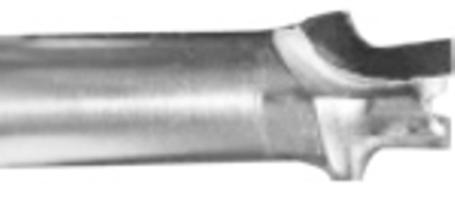
Magnate 2310 Dovetail PCD Router Bit for CNC - 15mm Cutting Diameter; 10mm Small Diameter; 8.99mm Cutting Height; 2 Flute, 20 inclusive Degree (10 Degree), 1/2" Shank Diameter, 2" Overall Length

Dovetail tool allows for use on CNC machines. For use with material thicknesses of 3/8" to 1/2". Mating dovetail joint is cut with 1/4" straight spiral.

Please note: Product images are for illustrative purposes and may vary from the actual item.

PCD (Polycrystalline Diamond) tooling provides exceptional wear resistance when cutting abrasive materials. It is not recommended for hand-operated tools but performs exceptionally well in CNC woodworking applications, including cutting plastics and non-ferrous metals. When used properly, end users can expect 30 times the tool life when compared to carbide. Not only does it wear evenly and increase tool life, PCD use cuts down on the end user's tool change and setup time which saves money and increases productivity Compression-style flutes help minimize chipping and delamination for cleaner, more precise cuts.

When manufacturer RPM specifications are not available, the following RPM ranges may be used as general starting guidelines for CNC woodworking applications 1) 1/4” to 3/8” diameter bits: 18,000 to 24,000 RPM 2) 1/2” to 5/8” diameter bits: 16,000 to 22,000 RPM 3) 3/4” to 1” diameter bits: 12,000 to 18,000 RPM 4) 1-1/4” to 1-1/2” diameter bits: 9,000 to 16,000 RPM 5) 2” to 2-1/2” diameter bits: 6,000 to 12,000 RPM 6) 3” diameter bits: 5,000 to 8,000 RPM RPM should be adjusted according to cutter diameter to maintain the appropriate surface (cutting) speed, while actual RPM and feed rate may vary depending on material, tool geometry, chip load, and application. Always follow the manufacturer's recommended and maximum RPM specifications.
more info

List Price: $357.54
Our Price: $321.79
Savings: $35.75
Qty Add
To add the above items to your cart, click the "Add" checkboxes then click "Add To Cart" >>>
   
 
PCD (Polycrystalline Diamond) bits perform exceptionally well in CNC woodworking applications even when used on plastics and non-ferrous metals. Some examples of uses include those with panel saw blades, router bits and cutter heads, and many more. PCD tooling is not recommended for hand operated tools. PCD comprises of a polycrystalline aggregate of manufactured diamonds approximately 0.6 - 0.8mm thick bonded to a substrate of cemented tungsten carbide 1 - 2.7mm thick. The composite substance combines the hardness and high thermal conductivity of diamond with the brazeability of tungsten carbide. The micron-sized manufactured diamonds are randomly oriented to give consistent wear-resisting properties in all directions. PCD is the hardest man-made material in the world. It is excellent cutting material because it wears exceptionally well. The micron-sized manufactured diamonds of PCD are randomly oriented to give consistent wear across the cutting edge. The wear rate of PCD cutting edges is not only much less then carbide, but also much more even; PCD wears by erosion rather than edge breakdown. When used properly, end users can expect 30 times the tool life when compared to carbide; In some cases, up to 120 times the tool life. Not only does it wear evenly and increase tool life, PCD use cuts down on the end user's tool change and setup time which saves money and increases productivity